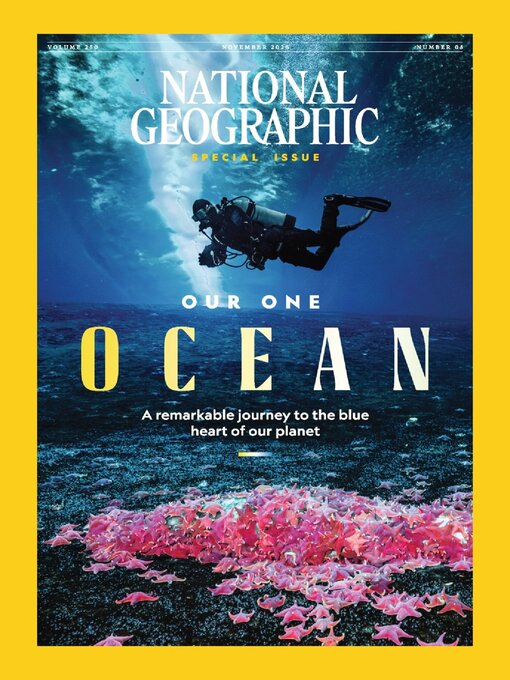
 Nov 01 2026
 Oct 01 2026
 Sep 01 2026
 Aug 01 2026
 Jul 01 2026
 Jun 01 2026
 May 01 2026
 Apr 01 2026
 Mar 01 2026
 Feb 01 2026
 Jan 01 2026
 Dec 01 2025
 Nov 01 2025
 Oct 01 2025
 Sep 01 2025
 Aug 01 2025
 Jul 01 2025
 Jun 01 2025
 May 01 2025
 Apr 01 2025
 Mar 01 2025
 Feb 01 2025
 Jan 01 2025
 Dec 01 2024
What's inside the yellow box? Amazing discoveries and experiences await you in every issue of National Geographic magazine.
FROM the EDITOR
Our WORLD
At sea with the world’s greatest navigators • While documenting how contemporary voyagers are preserving Oceania’s ancestral seafaring traditions (“The Wayfinder Within,” p. 96), Hannah Reyes Morales spent two nights aboard a double-hulled canoe between Tahiti and Bora Bora. Watching the crew navigate without instruments, relying only on their understanding of astronomy, winds, and swells, was a reminder that such knowledge is “not a relic of the past,” Morales says. “It needs to be practiced to continue to survive.” The work of this London-based photographer has been honored by Pictures of the Year International and World Press Photo awards.
THE CORAL CURE
WHERE GIANTS DWELL
SURFACING NEW WONDER IN SEYCHELLES • Researcher Sheena Talma is on a mission to democratize deep-sea science—starting with the first thorough exploration of the island nation she calls home.
THE OCEAN'S FOREST
AN OASIS AT THE TOP OF THE WORLD • High in the Canadian Arctic, a small bay is an unlikely hotbed for animal life of all kinds. Oceanographer Kristina Brown is working with local communities there to understand why.
WHAT BUBBLES BENEATH?
SOMETHING FISHY IN THE ANTARCTIC • At the bottom of the sea, marine scientist Manuel Novillo has witnessed something new and unexpected: fish getting intoxicated at hydrothermal vents.
THE WAYFINDER WITHIN
They Saved Paradise
Editorial
The GEAR That Kept A HERO AFLOAT • THE TRAILBLAZING oceanographer Sylvia Earle once wore this sea-beaten vest, designed to help divers rise, sink, or hover by adding or releasing air. Earle, a National Geographic Explorer at Large and Rolex Testimonee, led the first all-woman aquanaut research team in 1970 and later served as the National Oceanic and Atmospheric Administration’s first female chief scientist. Now 91 and still diving, she counts herself lucky to have launched her career at the advent of scuba—and the current moment, she suggests, is similarly auspicious for young scientists. “It is becoming more normal to protect than to destroy,” Earle says. “If you could choose a time to be a human being on Earth, I think in some ways it’s the best time ever.”